

BehAIve: Behaviour Monitoring and Support of Older Adults
Open positions:
Open position at the University of Applied Sciences Wismar:here
Open position at DZNE:here
Open positions at the University of Greifswald:
Doctoral researcher in the sub-project “Multimodal Behaviour Analysis and Support”
Postdoctoral researcher in the sub-project “Multimodal Behaviour Analysis and Support”
Doctoral researcher in the sub-project “Scalable Systems for Multimodal Data Analysis”
Open positions at the University Medicine Greifswald:
Doctoral / Postdoctoral researcher in the sub-project “Intelligent Interventions and Support of Geriatric Patients”
Project Summary
Germany is undergoing profound demographic change, characterised by an ageing population and declining birth rates. This development is accompanied by an increase in age-related chronic diseases – and thus a significant growth in the need for long-term care. Particularly serious is the increase in cognitive impairments such as mild cognitive impairment and dementia, which require a high level of care. At the same time, the shortage of nursing staff is reaching alarming proportions. In view of these challenges, innovative solutions are needed.
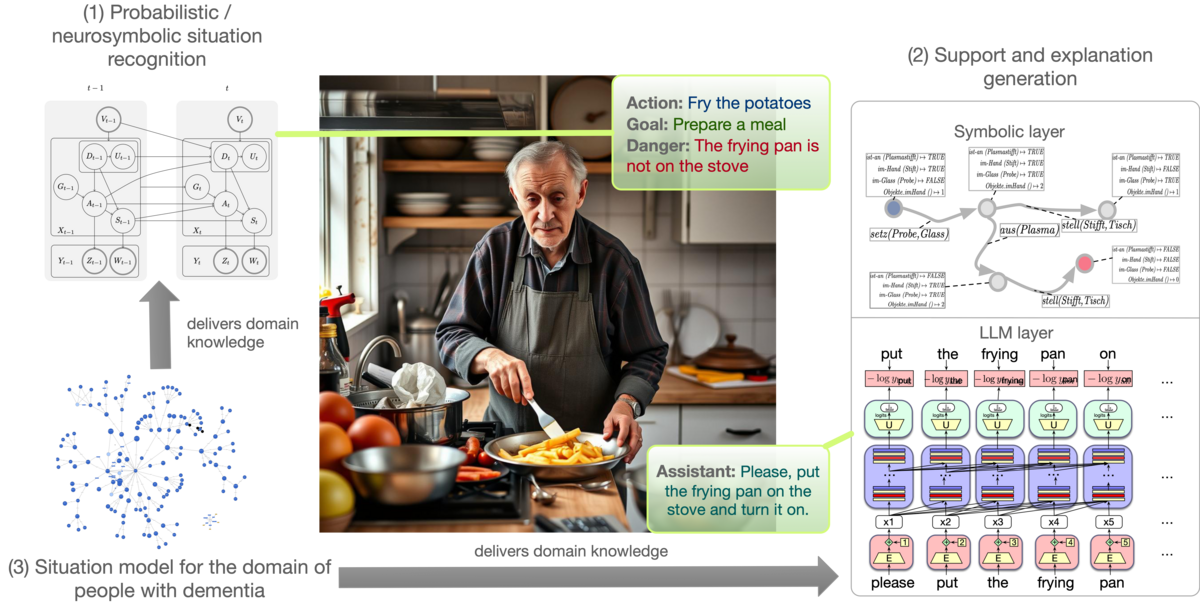
The BehAIve project is making a promising contribution in this area. It aims to develop an AI-supported, situation-adaptive system to support older people in their everyday lives or geriatric patients during hospital stays. Continuous monitoring using sensors will analyse people's behaviour, identify problematic behaviours and offer targeted support where necessary. This can significantly improve the quality of life of people with cognitive impairments or geriatric patients – while also reducing the workload of nursing staff.
The project is divided into 8 subprojects addressing the technological and application aspects of the system. Furthermore, the ethical and privacy aspects are also considered.
Sub-project 1:Multimodal Behaviour Analsis and Support
PI: Kristina Yordanova, Institute of Data Science, Unversity of Greifswald
The sub-project ‘Multimodal Behaviour Analysis and Interaction’ deals with the development and implementation of methods for automatic knowledge extraction, multimodal behaviour analysis and language-based interaction.
Sub-project 2:Hybrid Neurosymbolic and Neuroprobabilistic Models for the Analysis of Dynamic Systems
PI: Thomas Kirste, Hybrid Methods in Artificial Intelligence and Machine Learning Group, University of Rostock
The sub-project ‘Hybrid Neurosymbolic and Neuroprobabilistic Models for the Analysis of Dynamic Systems’ deals with the Provision of the system component for activity and situation recognition, development of scenario-specific parameterisation for this component, and its continuous further development and adaptation based on the results of the system evaluation.
Sub-project 3:Automatic Knowledge Extraction and Learning of Situation Models
PI: Frank Krüger, Data Science and Machine Learning Group, University of Applied Sciences Wismar
The sub-project 'Automatic Knowledge Extraction and Learning of Situation Models' deals with the Identification and extraction of information from structured and unstructured sources so that a machine-interpretable description of instructions can be generated (situation model), which is used to create causal models of human behaviour.
Sub-project 4:Scalable Systems for Multimodal Data Analysis
PI: Ralf Schneider, University Computing Centre, University of Greifswald
The sub-project ‘Scalable Systems for Multimodal Data Analysis’ deals with the development and implementation of methods for multimodal behaviour analysis and the development of scalable sensor- and speech-based systems for recording human behaviour.
Sub-project 5: Contextadaptive Explanation and Interaction for People with Mild Cognitive Impairments
PI: Stefan Teipel and Martin Dyrba, German Centre for Neurodegenerative Diseases
The sub-project ‘Contextadaptive Explanation and Interaction for People with Mild Cognitive Impairments’ deals with the user-centred development of the system for people with MCI, including the development and application of participatory methods of technology co-design. Furthermore, under the leadership of Dr Martin Dyrba, the DZNE is responsible for the development of explainable voice-based interfaces to support users.
Sub-project 6: Intelligent Interventions and Support for People with Mild Cognitive Impairments
PI: Agnes Flöel, Klinik für Neurologie, Universitätsmedizin Greifswald
The sub-project ‘Intelligent Interventions and Support for People with Mild Cognitive Impairments’ deals with the identification of study participants with MCI, as well as the development of baseline measurements and the corresponding target parameters. It is also responsible for the evaluation of the results in terms of cognitive parameters and identificators of quality of life.
Sub-project 7: Intelligent Interventions and Support of Geriatric Patients
PI: Maximillian König, Geriatrie, Universitätsmedizin Greifswald
The sub-project ‘Intelligent Interventions and Support of Geriatric Patients’ deals with the identification of study participants in the use case “Geriatrics”, as well as the development of baseline measurements and the corresponding target parameters. It is also responsible for the evaluation of the results in terms of cognitive parameters and identificators of quality of life.
Subproject 8: Explainable and Ethical AI Methods
PI: Giovanni Rubeis, Institut für Ethik und Geschickte der Medizin
The sub-project ‘Explainable and Ethical AI Methods’ deals with the creation, implementation and evaluation of a roadmap for explainable AI (XAI). In close cooperation with relevant stakeholders in the project, a method for ensuring XAI is to be implemented and documented for further ethical research.